Nishio-san
The Character of RainNishio-san is the narrator’s Japanese nanny and one of the defining figures of his early childhood: she gives his childhood status practical meaning through patient, generous care, then saves him from drowning in the koi pool. The narrator places her within two formative experiences—his discovery of language and the special treatment of a young child—and later identifies her as the person whose intervention returned him to life. His account also links her to the limits and uncertainties of memory: he presents later recollections as firsthand, but frames the earliest period through what others have told him.
Identity and Introduction
Nishio-san speaks only Japanese, yet the narrator says that he understands everything she tells him. Her name is his fifth word. That detail belongs to a broader childhood theory about language: after naming people around him, he concludes that they need him to help them exist. Nishio-san’s name thus enters the account not merely as a label, but as one of the early words through which he makes sense of his influence on other people and of the power of speech.
The narrator describes her as goodness itself, devoted to him with seemingly inexhaustible patience. She is also a mother of ten-year-old identical twin daughters. She does not distinguish the girls by their first names, instead calling them futago, a Japanese term the narrator initially mistakes for the name of one child. When the twins come to the house and both answer her call, he discovers that the word refers to them together. This small episode gives her care for him a family context: Nishio-san’s attention to the narrator exists alongside her life as the mother of two daughters.
Care and the Sacred Child
The narrator understands Nishio-san’s indulgence through the special standing he believes Japanese society grants a child before nursery school. He describes such a child as an okosama, a highly honored or lordly child, and says Nishio-san treats him as a divinity. His older brother, sister, and Nishio-san’s twins have passed beyond that stage, in his account, and are addressed in ordinary ways; he alone receives the sacred status of the very young child.
Her attentiveness appears in the daily routine of the kitchen. When he comes downstairs in the morning, Nishio-san bends to his height and gives him what he asks for. If he wants food from her plate, she lets him take as much as he wants and waits to eat until he has finished—even when he leaves her little or nothing. The narrator’s mother sees this at lunch and sharply asks Nishio-san not to let herself be tyrannized. The rebuke does not end the practice: as soon as his mother turns away, the child resumes it.
The narrator explains his persistence in concrete terms. Nishio-san’s okonomiyaki, a cabbage pancake with shrimp and ginger, and her tsuke-mono rice, with horseradish in yellow saffron brine, appeal to him more than the pureed carrots and small pieces of meat served at home. The episode shows both the generosity of Nishio-san’s care and the child’s willingness to exploit it. It also sets her domestic kindness against his mother’s effort to impose limits, without suggesting that Nishio-san herself understands the situation in the same terms as the later narrator.
Departure and Family Responsibilities
Nishio-san eventually tells the narrator’s father that she is leaving. She explains that she has too much work, is tired, and needs more time at home to care for her ten-year-old daughters, who need their mother. Her decision is presented as a choice grounded in family responsibility, not as a dispute with the household. The narrator’s parents have to accept it.
Her departure changes the arrangement through which she has cared for the narrator. The account sets her devotion to him beside the needs of her own children: the twins’ age and dependence, which had previously appeared in the story as part of his discovery of the word futago, now become the stated reason she must spend more time at home. Nishio-san is therefore not only the patient caregiver remembered from the narrator’s childhood but also a parent whose obligations extend beyond him.
Rescue and the Narrator’s Retrospective Account
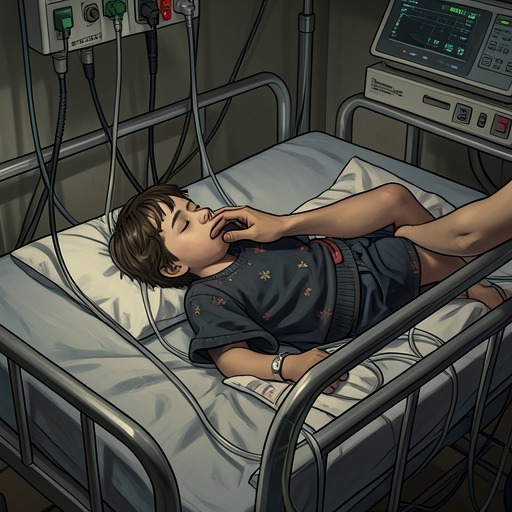
At three, the narrator enters the carp pool wanting to be in the water. He describes a sensation of life coming apart and of moving back toward a tube-like, pre-conscious state. A hand seizes him and shakes him back into awareness. He then identifies Nishio-san: air returns to his lungs, he screams, and he is alive and able to see. Nishio-san also screams for help, runs into the house carrying him, and finds his mother, who reacts with alarm.
The narrator later calls this his first and, at the time of writing, only suicide attempt. He says that he never told his parents that the incident was not an accident. The account does not make Nishio-san the cause of the attempt or claim that she knew his intention; it establishes her as the person who intervened when he was dying. The narrator retains a scar on his left temple, which he offers as material confirmation when he wonders whether he dreamed or invented the episode. His own recollection of feeling at home in the water remains part of the same uncertain retrospective account.
Memory and Narrative Significance
The narrator says that the white chocolate gave him both an identity and a memory, and that he remembers everything after February 1970. He concedes that this sweeping claim cannot be proved or disproved and says that before the white chocolate he remembers nothing, relying instead on what others tell him. His distinction between earlier, mediated knowledge and later firsthand memory frames the account of Nishio-san: her role belongs to a childhood that the adult narrator presents as personally remembered, while he openly acknowledges the limits of what can be verified.
Within that recollection, Nishio-san’s significance is expressed through contrasting actions. She accommodates the child’s demands at the table, even after his mother objects; later, when he is in danger, she acts immediately, calls for help, and carries him to his mother. The first episode makes her care part of an everyday household rhythm, while the rescue gives that care a decisive consequence. Together, these scenes make her a central presence in the narrator’s remembered childhood: at once the indulgent caregiver who helps sustain his sense of exceptional status and the person whose intervention ends his attempt to disappear.